



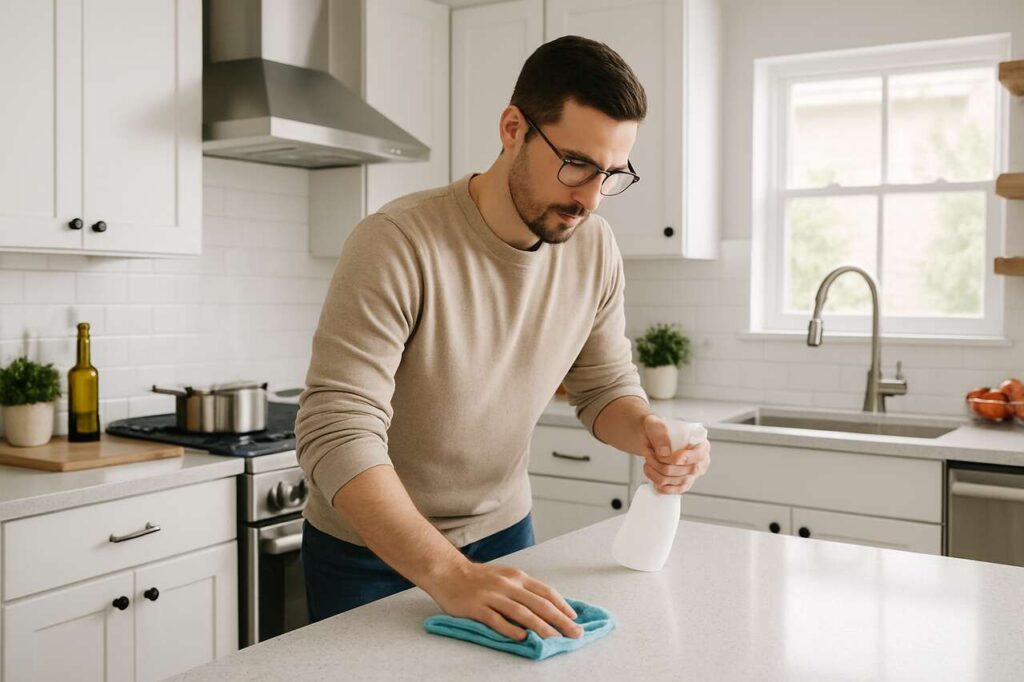
The kitchen reveals more about personality than many realise. Observing someone navigate meal preparation offers a window into their psychological makeup, particularly when it comes to tidying as they go. Those who instinctively wipe surfaces, wash utensils, and restore order whilst cooking aren’t simply neat; they possess a distinct constellation of psychological traits that shape how they approach tasks, relationships, and daily life. Research in behavioural psychology suggests that this simultaneous cooking and cleaning behaviour correlates with specific cognitive patterns and emotional tendencies that extend far beyond the kitchen counter.
The sense of reciprocity at the heart of action
Understanding the reciprocity principle in domestic settings
People who clean whilst cooking often operate from a deeply ingrained sense of reciprocity. This psychological principle, extensively studied in social psychology, drives individuals to balance what they take with what they give back to their environment and the people around them. When cooking in a shared space, these individuals recognise that they’re temporarily disrupting a communal area, and their cleaning behaviour represents an immediate effort to restore equilibrium.
This reciprocal mindset manifests in several observable ways:
- Washing borrowed equipment before returning it to cupboards
- Wiping surfaces immediately after creating mess
- Disposing of packaging and scraps as soon as they’re generated
- Leaving the kitchen in a state equal to or better than how they found it
The psychological roots of balanced exchange
Research indicates that individuals with heightened reciprocity awareness experience discomfort when they perceive an imbalance in give-and-take dynamics. In the kitchen context, creating mess without immediate remediation triggers a psychological debt that these individuals feel compelled to address. This isn’t merely about cleanliness but rather about maintaining equilibrium in their relationship with shared spaces and the people who use them.
| Reciprocity Behaviour | Psychological Driver | Kitchen Manifestation |
|---|---|---|
| Immediate cleaning | Discomfort with imbalance | Washing utensils between cooking stages |
| Space restoration | Respect for shared resources | Returning items to original locations |
| Preemptive tidying | Anticipating others’ needs | Clearing surfaces before others arrive |
This reciprocal orientation extends beyond the kitchen, influencing how these individuals approach professional collaborations, friendships, and family dynamics. Understanding this behaviour pattern reveals something fundamental about the discomfort certain personalities experience when tasks remain incomplete.
Discomfort with unfinished tasks
The psychological weight of incomplete actions
Those who clean whilst cooking typically experience significant cognitive discomfort with unfinished tasks, a phenomenon psychologists refer to as the Zeigarnik effect. This mental state creates persistent tension when actions remain incomplete, generating a background anxiety that diminishes only when tasks reach resolution. For these individuals, a sink full of dirty dishes isn’t simply a visual inconvenience; it represents unfinished business that occupies mental resources and creates psychological pressure.
The drive for cognitive closure
Psychologist Arie Kruglanski’s research on the need for cognitive closure illuminates this trait particularly well. Individuals with high closure needs seek definitive answers and completed states, experiencing discomfort with ambiguity and open-ended situations. In practical terms, this manifests as:
- An inability to relax whilst knowing mess awaits attention
- Difficulty enjoying meals when the kitchen remains disordered
- A compulsion to complete cleaning cycles before moving to other activities
- Preference for sequential task completion rather than parallel processing
Managing mental load through immediate action
Research demonstrates that unfinished tasks occupy working memory, consuming cognitive resources even when attention focuses elsewhere. By addressing cleaning simultaneously with cooking, these individuals effectively reduce their mental load, freeing cognitive capacity for other demands. This isn’t merely about physical tidiness but rather about managing psychological bandwidth efficiently.
The discomfort with incompletion often stems from a broader personality orientation towards order and resolution, which naturally connects to how these individuals perceive their role in social settings and their responsibility towards others who share their space.
The importance of hospitality and relieving the host’s burden
Empathy-driven cleaning behaviour
People who clean whilst cooking frequently demonstrate elevated empathy levels, particularly regarding the burden their activities place on others. When cooking in someone else’s home or even in their own shared kitchen, they remain acutely aware that their meal preparation creates work for someone—whether themselves later or another household member. This awareness drives immediate corrective action.
The psychology of considerate behaviour
This trait reflects what psychologists call perspective-taking ability—the capacity to mentally inhabit another person’s viewpoint and anticipate their needs or concerns. In kitchen contexts, this manifests as:
- Cleaning up during cooking to minimise post-meal work
- Anticipating which surfaces and tools others might need
- Reducing the visual and practical burden on household members
- Creating space for others to participate comfortably in meal preparation
| Empathetic Behaviour | Underlying Motivation | Practical Outcome |
|---|---|---|
| Continuous surface wiping | Reducing others’ cleaning burden | Kitchen remains usable throughout cooking |
| Immediate dish washing | Preventing overwhelming cleanup | Manageable post-meal tidying |
| Organised workspace maintenance | Facilitating others’ kitchen access | Multiple people can work simultaneously |
Hospitality as a core value
For these individuals, hospitality extends beyond serving food to encompass the entire experience of shared domestic space. They recognise that true hospitality means minimising the disruption and burden their presence creates. This psychological orientation often develops from early socialisation experiences where consideration for others was emphasised and modelled.
This empathetic awareness naturally leads to a broader pattern of anticipatory behaviour that characterises how these individuals approach challenges and opportunities in daily life.
Proactivity: acting rather than reacting
The proactive personality type
Cleaning whilst cooking exemplifies proactive rather than reactive behaviour, a fundamental personality distinction in psychological research. Proactive individuals identify potential problems before they fully materialise and take preventative action. In the kitchen, this means addressing mess as it occurs rather than waiting for it to accumulate into a larger, more daunting task.
Anticipatory problem-solving
This proactive orientation involves future-focused thinking that constantly evaluates current actions for their downstream consequences. Those who clean whilst cooking mentally project forward, recognising that:
- Small messes compound into overwhelming cleanup if left unaddressed
- Dried food residue becomes exponentially harder to remove
- Accumulated dishes create psychological resistance to cleaning
- Immediate action requires less total effort than delayed response
Executive function and self-regulation
The ability to engage in proactive cleaning demonstrates enhanced executive function—the cognitive processes that enable planning, impulse control, and goal-directed behaviour. Rather than succumbing to the temptation to leave cleaning for later, these individuals exercise self-regulation, prioritising long-term ease over short-term convenience.
| Proactive Behaviour | Reactive Alternative | Psychological Advantage |
|---|---|---|
| Washing as you go | Post-meal marathon cleaning | Reduced cognitive load and stress |
| Immediate spill management | Dealing with dried, stubborn stains | Lower frustration and effort |
| Continuous organisation | Navigating cluttered workspace | Enhanced efficiency and safety |
This proactive stance reflects a personality that seeks control over circumstances rather than passively responding to conditions as they arise, which connects directly to the psychological satisfaction these individuals derive from active participation and contribution.
The comfort of contribution
Deriving satisfaction from useful action
People who clean whilst cooking often experience psychological comfort through contribution—they feel most at ease when actively adding value to their environment or social group. This trait reflects what psychologists call a “contribution orientation,” where self-worth and satisfaction derive partly from being useful and productive.
The psychology of productive engagement
For these individuals, passive consumption or inactivity generates discomfort, whilst productive engagement provides psychological reward. In kitchen settings, this manifests as an inability to simply sit whilst others work or to leave tasks for others to complete. The act of cleaning whilst cooking satisfies this need to contribute meaningfully.
Key psychological elements include:
- Discomfort with being perceived as lazy or unhelpful
- Satisfaction derived from visible progress and accomplishment
- Enhanced self-esteem through productive activity
- Anxiety reduction through purposeful engagement
Identity and self-concept
This contribution orientation often forms part of these individuals’ core identity. They see themselves as helpful, productive people, and their behaviour aligns with this self-concept. Cleaning whilst cooking isn’t simply a habit but rather an expression of who they understand themselves to be—someone who contributes rather than creates burden.
This need to contribute productively intersects with a heightened awareness of how individual actions affect collective functioning, particularly in group settings where multiple people share responsibility for outcomes.
Sensitivity to group dynamics
Awareness of collective functioning
Those who clean whilst cooking typically demonstrate heightened sensitivity to group dynamics—they remain constantly aware of how their behaviour affects others and the overall functioning of shared spaces. This psychological trait involves monitoring both the physical environment and the social atmosphere, adjusting behaviour to maintain harmony and efficiency.
Social intelligence in domestic settings
This sensitivity reflects what psychologists term social intelligence—the ability to navigate complex social environments effectively. In kitchen contexts, socially intelligent individuals recognise that:
- Mess creates tension in shared households
- Cleanliness standards vary among individuals, requiring compromise
- Visible effort to maintain order reduces interpersonal conflict
- Shared responsibility for cleanliness strengthens group cohesion
Conflict avoidance and relationship maintenance
Research published in behavioural psychology journals demonstrates that cleanliness-related conflicts represent a significant source of household tension. Individuals who clean whilst cooking often possess acute awareness of this potential friction point and take preventative action. Their cleaning behaviour serves not only practical purposes but also functions as relationship maintenance, reducing potential sources of interpersonal stress.
| Group Dynamic Awareness | Cleaning Behaviour | Relational Benefit |
|---|---|---|
| Recognising others’ cleanliness standards | Maintaining higher tidiness levels | Reduced household conflict |
| Anticipating shared space needs | Keeping surfaces clear and accessible | Enhanced cooperation |
| Monitoring group stress levels | Proactive mess prevention | Improved household atmosphere |
Reading and responding to social cues
These individuals excel at reading subtle social cues that indicate when their behaviour might be creating burden or discomfort for others. They notice when household members seem stressed by mess, when shared spaces feel chaotic, or when their cooking activities encroach on others’ needs. This perceptiveness drives immediate corrective action, demonstrating sophisticated emotional and social intelligence that extends well beyond kitchen contexts into all areas of interpersonal functioning.
The behaviour of cleaning whilst cooking emerges from a complex interplay of psychological traits including reciprocity awareness, discomfort with incompletion, empathetic consideration, proactive problem-solving, contribution orientation, and social sensitivity. These characteristics combine to create individuals who approach not only cooking but life more broadly with organisation, consideration, and forward-thinking responsibility. Understanding these traits offers insight into personality patterns that influence everything from workplace behaviour to relationship dynamics, revealing that even mundane domestic habits reflect deeper psychological structures that shape how people navigate their world.