



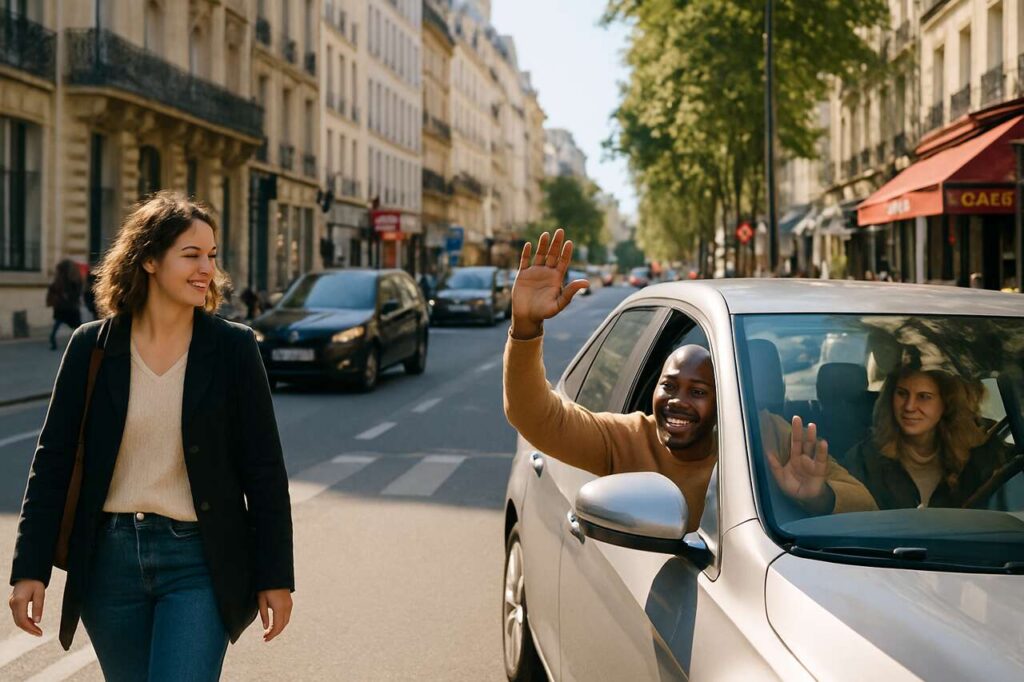
A simple wave of acknowledgement to a driver who has stopped at a pedestrian crossing might seem like an inconsequential act, yet this small gesture carries profound psychological significance. Researchers examining everyday social interactions have discovered that this brief moment of gratitude reveals distinct personality characteristics and reflects deeper patterns of human behaviour. The act of thanking drivers through a wave, nod, or smile has become a subject of interest for psychologists seeking to understand what separates those who consistently perform this gesture from those who do not. This seemingly trivial behaviour offers a window into individual differences in social awareness, emotional intelligence, and community-mindedness.
The reasons for the thanking gesture
The impulse to wave at drivers stems from multiple psychological motivations that intertwine social conditioning with personal values. At its core, this gesture represents an acknowledgement of cooperation in shared public spaces where rules and courtesy must coexist.
Recognition of mutual respect
Individuals who wave to thank drivers demonstrate an acute awareness of the social contract that governs road use. When a driver yields the right of way, particularly in situations where they are not legally obligated to do so, the pedestrian recognises this as a voluntary act of consideration. The wave serves as:
- an acknowledgement that the driver has made a conscious choice to prioritise pedestrian safety
- a validation of the driver’s courteous behaviour
- a reinforcement of positive social norms in traffic situations
- a momentary connection between strangers sharing public infrastructure
Gratitude as a social lubricant
Research in social psychology indicates that expressing gratitude, even in fleeting interactions, strengthens community bonds and promotes prosocial behaviour. Those who wave to drivers often possess a heightened sensitivity to kindness, viewing the driver’s action not as an obligation but as a favour worthy of appreciation. This perspective reflects a broader tendency to notice and value positive interactions throughout daily life.
| Behaviour type | Percentage of individuals | Associated trait |
|---|---|---|
| Regular thanking wavers | 58% | High agreeableness |
| Occasional wavers | 27% | Moderate social awareness |
| Non-wavers | 15% | Low reciprocity tendency |
Understanding why people engage in this behaviour naturally leads to questions about what this simple act reveals regarding their underlying character traits.
What the gesture reveals about your personality
The consistent practice of waving to thank drivers serves as a behavioural marker for several personality dimensions that psychologists have identified through observational studies and self-report measures.
Heightened empathy and perspective-taking
People who regularly acknowledge drivers demonstrate enhanced empathetic abilities. They can mentally position themselves in the driver’s seat, recognising that stopping requires attention, decision-making, and a brief interruption to the driver’s journey. This capacity for perspective-taking indicates:
- stronger theory of mind abilities
- greater emotional intelligence
- improved capacity to recognise others’ intentions
- heightened sensitivity to social cues
Conscientiousness and social responsibility
The thanking gesture reflects a conscientious approach to social interactions. Individuals who perform this act tend to score higher on measures of dutifulness and adherence to social norms. They view the wave not as optional but as an appropriate response that maintains the fabric of civil society. This trait extends beyond road interactions to encompass workplace behaviour, personal relationships, and community engagement.
Positive affectivity
Research suggests that those who wave to drivers often exhibit higher baseline levels of positive emotion. They approach daily interactions with optimism and are more likely to interpret ambiguous situations favourably. This positive outlook makes them more inclined to notice and respond to kindness, creating a self-reinforcing cycle of positive social exchanges.
These personality indicators connect to broader psychological principles governing how humans navigate seemingly insignificant daily interactions.
The psychology of trivial gestures
Psychologists have long recognised that micro-behaviours in everyday life provide valuable insights into personality structure and social functioning. The wave to a driver exemplifies how trivial gestures carry disproportionate psychological weight.
The power of small acknowledgements
Despite their brevity, these gestures activate reciprocity mechanisms deeply embedded in human psychology. When a pedestrian waves, the driver experiences a moment of validation that can influence their subsequent behaviour. Studies have documented that drivers who receive acknowledgement are more likely to yield again in future encounters, creating a positive feedback loop that enhances overall traffic courtesy.
Symbolic communication in public spaces
The thanking wave functions as symbolic communication that transcends verbal language. In the absence of direct conversation, this gesture conveys multiple messages simultaneously:
- I recognise your action
- I appreciate your consideration
- I acknowledge our shared humanity
- I endorse this type of behaviour
Impact on subjective well-being
Engaging in gratitude expressions, even momentary ones, has been linked to improved psychological well-being. Individuals who regularly thank drivers report experiencing more positive emotions throughout their day. This phenomenon aligns with broader research on gratitude practices, which consistently demonstrate benefits for mental health, life satisfaction, and social connectedness.
Yet despite these benefits and the apparent simplicity of the gesture, not everyone engages in this behaviour, raising questions about individual differences in social conduct.
Why not everyone does it
The absence of a thanking wave does not necessarily indicate rudeness or lack of appreciation. Multiple factors influence whether individuals perform this gesture, ranging from cultural background to cognitive load.
Cultural and regional variations
Social norms surrounding pedestrian-driver interactions vary considerably across cultural contexts. In some regions, thanking drivers is virtually universal and expected, whilst in others it remains uncommon. Individuals raised in environments where this gesture is not normative may simply not consider it part of appropriate pedestrian behaviour. Cultural differences in:
- expressiveness of gratitude
- formality of public interactions
- expectations of driver behaviour
- pedestrian right-of-way assumptions
all contribute to whether someone develops the habit of waving.
Cognitive preoccupation and distraction
Many individuals who do not wave are simply mentally elsewhere. Modern life presents constant cognitive demands, and pedestrians absorbed in thought, conversation, or mobile device use may cross roads on autopilot. This does not reflect personality deficits but rather the limitations of human attention when managing multiple mental tasks simultaneously.
Introversion and social anxiety
For some individuals, even brief social acknowledgements create mild discomfort. Those with introverted tendencies or social anxiety may experience the wave as drawing unwanted attention to themselves. They may appreciate the driver’s action internally whilst preferring to avoid the social exchange that a wave represents.
Perceived entitlement to right of way
A subset of non-wavers view yielding as the driver’s legal obligation rather than a courtesy. This perspective reflects a rights-based approach to social interactions where adherence to rules requires no special acknowledgement. Such individuals may possess equally strong moral frameworks but conceptualise pedestrian crossings differently.
These varying explanations prompt deeper questions about whether courteous behaviour stems from innate predispositions or learned social patterns.
Civility: an innate response ?
The question of whether polite gestures like thanking drivers emerge from biological predispositions or social learning has occupied researchers across developmental psychology and evolutionary biology.
Evolutionary perspectives on cooperation
From an evolutionary standpoint, humans possess innate tendencies towards reciprocal altruism and cooperation. Early human survival depended on group cohesion and mutual assistance, creating selective pressures that favoured individuals capable of recognising and rewarding cooperative behaviour. The thanking wave may represent a modern manifestation of these ancient mechanisms, adapted to contemporary urban environments.
Early childhood development of gratitude
Developmental research reveals that children as young as two years display rudimentary gratitude responses, suggesting some biological basis for appreciative behaviour. However, the specific forms that gratitude takes—including whether to wave at drivers—are clearly shaped by:
- parental modelling of courteous behaviour
- explicit instruction about social expectations
- reinforcement of polite gestures
- observation of community norms
The role of socialisation
Whilst humans may possess innate capacities for gratitude and reciprocity, the expression of these tendencies is profoundly influenced by socialisation. Children who observe parents consistently thanking drivers are significantly more likely to adopt this behaviour themselves. This suggests that civility, whilst potentially rooted in biological predispositions, requires environmental activation and reinforcement to manifest consistently.
These developmental and evolutionary considerations connect directly to specific personality characteristics that distinguish habitual wavers from non-wavers.
Associated personality traits
Psychological research has identified several core personality dimensions that correlate with the tendency to thank drivers through gestures of acknowledgement.
Agreeableness and prosocial orientation
The Big Five personality trait of agreeableness shows the strongest association with thanking behaviour. Highly agreeable individuals prioritise social harmony and demonstrate concern for others’ feelings. They are motivated to maintain positive interactions and avoid causing offence, making the thanking wave a natural extension of their interpersonal style.
Openness to experience
Surprisingly, openness to experience also correlates with this behaviour. Individuals high in openness tend to be more aware of their surroundings, notice subtle social dynamics, and appreciate the aesthetic and emotional dimensions of everyday interactions. They may view the exchange between pedestrian and driver as a meaningful micro-moment worthy of acknowledgement.
Low neuroticism and emotional stability
Those with lower neuroticism scores are more likely to engage in thanking gestures. Emotional stability allows individuals to maintain awareness of social niceties even under mild stress or time pressure. Conversely, those high in neuroticism may be too preoccupied with internal anxieties to consistently notice and respond to drivers’ courtesy.
| Personality trait | Correlation with thanking | Mechanism |
|---|---|---|
| Agreeableness | Strong positive | Prosocial motivation |
| Conscientiousness | Moderate positive | Adherence to social norms |
| Openness | Moderate positive | Environmental awareness |
| Neuroticism | Negative | Reduced social attention |
Gratitude as a stable trait
Beyond the Big Five, dispositional gratitude—the tendency to notice and appreciate positive aspects of life—strongly predicts thanking behaviour. Individuals with high trait gratitude possess a mental framework that highlights kindness and generosity in daily interactions. For them, waving to a driver is not a conscious decision but an automatic response consistent with their general orientation towards appreciation.
The simple act of waving to thank a driver thus emerges as a surprisingly rich indicator of personality, revealing patterns of empathy, social awareness, and gratitude that extend far beyond the pedestrian crossing. Whether rooted in innate predispositions or cultivated through social learning, this gesture represents a small but meaningful contribution to civil society. Those who consistently perform it demonstrate personality characteristics associated with psychological well-being, positive social relationships, and community engagement. Whilst not everyone engages in this behaviour for varied and understandable reasons, its practice offers benefits both to the individual and to the broader social fabric, reinforcing norms of courtesy and mutual respect in shared public spaces.