



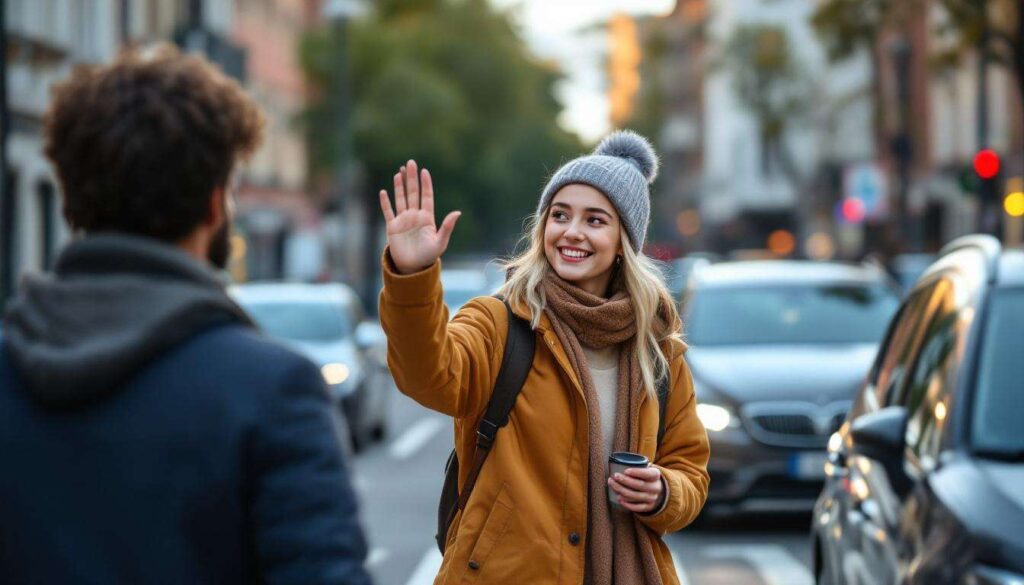
The simple act of raising a hand to thank a driver who stops at a pedestrian crossing might seem like nothing more than basic courtesy. Yet psychologists suggest this brief gesture reveals far more about our inner world than we might imagine. This everyday interaction, repeated countless times across cities and towns, serves as a window into personality traits, social values and the way individuals perceive their relationship with the community around them.
The psychology behind the gesture of thanks
Understanding gratitude as a psychological mechanism
Gratitude functions as a fundamental social emotion that strengthens bonds between individuals. When someone waves to acknowledge a driver’s patience, they activate psychological processes linked to reciprocity and social cohesion. Research in positive psychology demonstrates that expressing thanks, even in fleeting moments, triggers neural pathways associated with reward and emotional regulation. This micro-interaction reinforces prosocial behaviour and creates a ripple effect that extends beyond the immediate participants.
The gesture itself requires several cognitive steps: recognising the driver’s action, evaluating it as worthy of acknowledgement, and executing a visible response. This sequence reveals an individual’s capacity for situational awareness and their willingness to invest energy, however minimal, in maintaining social harmony. Those who consistently perform this action demonstrate an automatic response to kindness that psychologists associate with well-developed emotional intelligence.
The neuroscience of acknowledgement
Brain imaging studies have shown that both giving and receiving gratitude activate regions associated with social bonding and pleasure. The act of waving thanks stimulates the release of neurochemicals that contribute to feelings of wellbeing. This biological response suggests that such gestures serve an evolutionary purpose, reinforcing cooperative behaviours that benefit group survival. The individuals who naturally engage in these acknowledgements may possess heightened sensitivity to social rewards, making them more attuned to opportunities for positive interaction.
These neurological foundations help explain why some people feel compelled to wave whilst others cross without acknowledgement. The variation reflects differences in how brains process social information and assign value to communal gestures. Beyond mere habit, this behaviour connects to deeper patterns of how we navigate our social environment.
Personality traits revealed by a simple gesture
Agreeableness and social orientation
Psychological research consistently links the tendency to thank drivers with high agreeableness, one of the five major personality dimensions. Individuals scoring highly on this trait prioritise harmony, demonstrate empathy, and show concern for others’ feelings. The wave becomes a natural extension of their interpersonal style, reflecting an innate desire to maintain positive social exchanges.
- Enhanced empathy towards others in shared public spaces
- Greater awareness of social expectations and norms
- Tendency to assume positive intentions in others’ actions
- Preference for cooperative rather than competitive interactions
- Heightened sensitivity to the emotional climate of situations
Conscientiousness and social responsibility
Those who wave to drivers often exhibit elevated conscientiousness, demonstrating attention to social duties and obligations. They view the gesture not as optional but as part of their responsibility as pedestrians sharing public space. This trait manifests in their careful observation of social protocols and their commitment to fulfilling perceived expectations, however minor they might appear.
Extraversion and social engagement
Whilst not exclusively linked to extraverts, the gesture correlates with comfort in social visibility. Extraverted individuals often find such public acknowledgements energising rather than awkward, viewing them as opportunities for brief connection. They experience less self-consciousness about being noticed and may even derive satisfaction from the momentary interaction, however impersonal it might be.
| Personality Trait | Expression in Gesture | Underlying Motivation |
|---|---|---|
| Agreeableness | Consistent acknowledgement | Maintaining social harmony |
| Conscientiousness | Dutiful response | Fulfilling social obligations |
| Extraversion | Visible, energetic wave | Enjoying social connection |
| Openness | Varied expressions | Adapting to context |
Understanding these personality correlations provides insight into the motivations driving this common behaviour, setting the stage for exploring why certain individuals adopt it whilst others do not.
Why do some people adopt this behaviour ?
Cultural and familial influences
The practice of waving to drivers often stems from childhood socialisation and cultural norms. Families that emphasise politeness and gratitude tend to raise children who internalise these values, carrying them into adulthood. Regional variations exist, with some communities viewing the gesture as essential whilst others consider it unnecessary. These learned behaviours become so ingrained that individuals perform them automatically, without conscious deliberation.
Personal experiences and reciprocity
Many people who wave regularly recall formative experiences where acknowledgement created positive feelings. Perhaps they remember being thanked as drivers themselves, or witnessed how a simple gesture brightened someone’s day. This reciprocity principle motivates continued behaviour: having benefited from courtesy, they feel compelled to perpetuate it.
- Memories of positive interactions as drivers or pedestrians
- Observation of role models demonstrating gratitude
- Personal satisfaction derived from polite exchanges
- Belief in the cumulative effect of small kindnesses
Worldview and social perception
Psychological research suggests that those who thank drivers tend to view the world through a cooperative rather than hostile lens. They interpret ambiguous social situations positively, assuming good intentions in others’ actions. This optimistic worldview makes them more likely to notice and appreciate considerate behaviour, prompting acknowledgement. Their baseline assumption is that most people want to do the right thing, making gratitude a natural response rather than a calculated decision.
These individual motivations connect to broader questions about what such gestures mean within the fabric of society.
The social meaning of the gesture
Building micro-communities through acknowledgement
Each wave to a driver contributes to an invisible network of civility that binds strangers together. These fleeting interactions create what sociologists call “weak ties”—brief connections that nonetheless foster a sense of community. In urban environments where anonymity prevails, such gestures remind participants of their shared humanity and mutual dependence. The pedestrian acknowledges the driver’s choice to prioritise their safety, whilst the driver receives validation for their consideration.
Trust and social capital
Regular exchanges of courtesy build social capital, the collective value of social networks and the inclinations that arise from them to do things for each other. Communities where such gestures are common often report higher levels of trust and cooperation. The wave signals that social norms are functioning, that people recognise and appreciate considerate behaviour, and that the social contract remains intact.
Communication beyond words
The gesture serves as non-verbal communication that transcends language barriers and personal differences. A raised hand conveys appreciation universally, requiring no translation or explanation. This simplicity makes it powerful: in seconds, two strangers acknowledge each other’s existence and worth, creating a moment of connection in otherwise disconnected lives.
These social dimensions reveal how individual actions scale up to influence collective wellbeing and community cohesion.
Deeper implications for daily life
Mental health and wellbeing connections
Regular expressions of gratitude, including waving to drivers, correlate with improved mental health outcomes. Studies demonstrate that individuals who frequently acknowledge others experience lower stress levels, reduced symptoms of depression, and greater life satisfaction. The act itself may seem trivial, but its cumulative effect on psychological wellbeing proves significant. Each gesture reinforces a positive mindset and strengthens neural pathways associated with optimism and social connection.
Influence on broader behaviour patterns
Those who wave to drivers often exhibit consistent patterns of courtesy across various contexts. The gesture reflects an underlying orientation towards kindness that manifests in holding doors, offering assistance, and expressing appreciation in professional settings. This consistency suggests that the behaviour serves as a reliable indicator of broader personality characteristics and values.
- Increased likelihood of volunteering and community involvement
- Higher rates of charitable giving and prosocial action
- Greater satisfaction in personal and professional relationships
- Enhanced resilience during challenging circumstances
Impact on observers and social modelling
The gesture influences not only the driver but also other pedestrians and drivers who witness it. Social learning theory suggests that observing courteous behaviour increases the likelihood that observers will replicate it. Children walking with adults who wave learn that this constitutes appropriate behaviour, perpetuating the practice across generations. The ripple effect extends far beyond the immediate interaction.
These individual and collective benefits underscore the importance of maintaining civility in everyday encounters.
The role of civility in our interactions
Civility as social infrastructure
Small courtesies like waving to drivers form the infrastructure of civil society. They establish baseline expectations for behaviour, creating an environment where people feel valued and respected. When these gestures disappear, social fabric weakens, potentially leading to increased aggression, reduced cooperation, and diminished quality of life. Maintaining civility requires ongoing effort from individuals who recognise its value.
Challenges in modern society
Contemporary life presents obstacles to maintaining courteous interactions. Digital distraction, time pressure, and urban anonymity all reduce opportunities for acknowledgement. Some individuals rush across crossings whilst looking at phones, missing the chance to thank drivers. Others feel self-conscious about performing visible gestures, fearing judgement or ridicule. These barriers highlight the intentionality required to preserve civil behaviour in changing social landscapes.
Cultivating gratitude as practice
Psychologists recommend viewing courtesy as a skill requiring cultivation rather than an innate trait. Individuals can consciously develop habits of acknowledgement, starting with simple gestures like waving to drivers. Over time, these practices become automatic, reshaping personality and improving social interactions. The effort invested yields returns in enhanced relationships, improved mood, and stronger community bonds.
The simple wave to a driver encapsulates profound truths about personality, social connection, and the values that sustain communities. Those who perform this gesture reveal agreeableness, conscientiousness, and a cooperative worldview. Their behaviour strengthens social bonds, builds trust, and contributes to collective wellbeing. Whilst the action takes mere seconds, its implications resonate throughout daily life, influencing mental health, social capital, and the quality of public spaces. In an era of increasing digital isolation, such face-to-face acknowledgements, however brief, remind us of our fundamental interdependence and shared humanity. The gesture matters not because it changes individual lives dramatically, but because it represents values worth preserving: gratitude, respect, and recognition of others’ kindness in the countless small moments that constitute everyday existence.